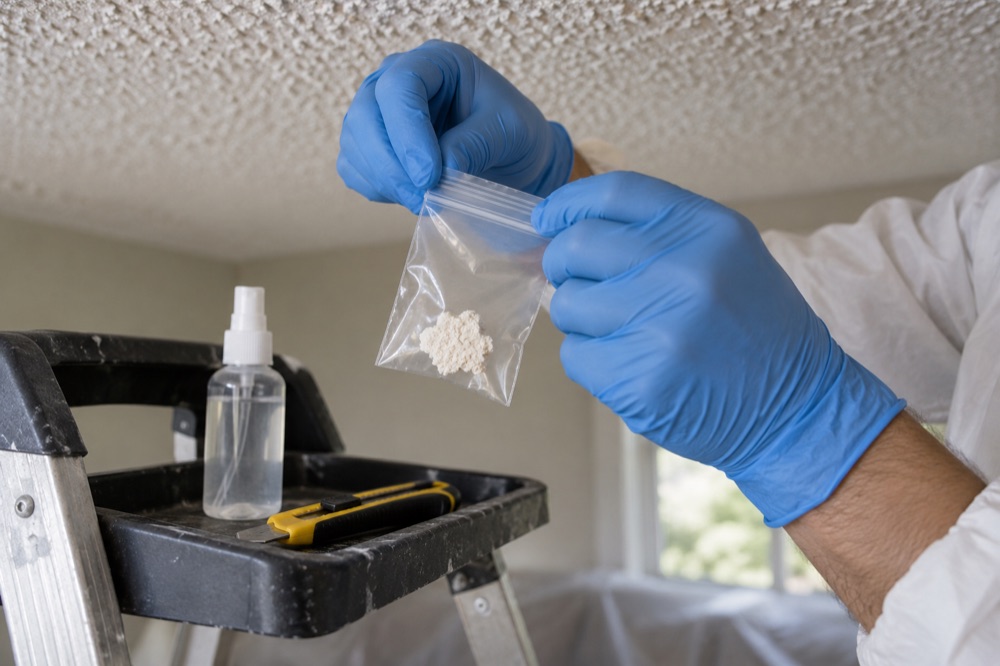
Why test a popcorn ceiling at all?
Some acoustic ceiling textures contained asbestos. Federal rules banned spray-applied asbestos for decorative use in 1978, but a date is not proof for any one ceiling. Materials already on hand could still be used, and ceilings were sometimes re-sprayed or patched years later. Sioux Falls has tens of thousands of homes built in the 1960s, 1970s and 1980s, so this question comes up on most of the ceilings we look at.
The EPA's homeowner guidance makes two points that shape how we work. First, you usually cannot identify asbestos by looking at it. Second, asbestos material that is in good shape and left alone is not likely to release fibers, but scraping, sanding, drilling and cutting can. Popcorn removal is scraping by definition. A lab test is the only way to know what you are dealing with before that happens.
An independent inspector, not us
We do not take the sample ourselves. We coordinate with an independent asbestos inspector who visits, takes the samples and sends them to an accredited laboratory. South Dakota DANR publishes a list of asbestos service providers in the state, including inspectors, and certifies asbestos inspectors, supervisors and workers under state rules.
There are two reasons for keeping the testing separate. The EPA suggests that the professional assessing asbestos should not be tied to the company that would remove it. And frankly, it protects you from anyone, including us, having a reason to read a result one way or another.
Our part is the coordination: scheduling the visit around your calendar, making sure every distinct ceiling area gets sampled, getting the report to you, and explaining what it means for the project.
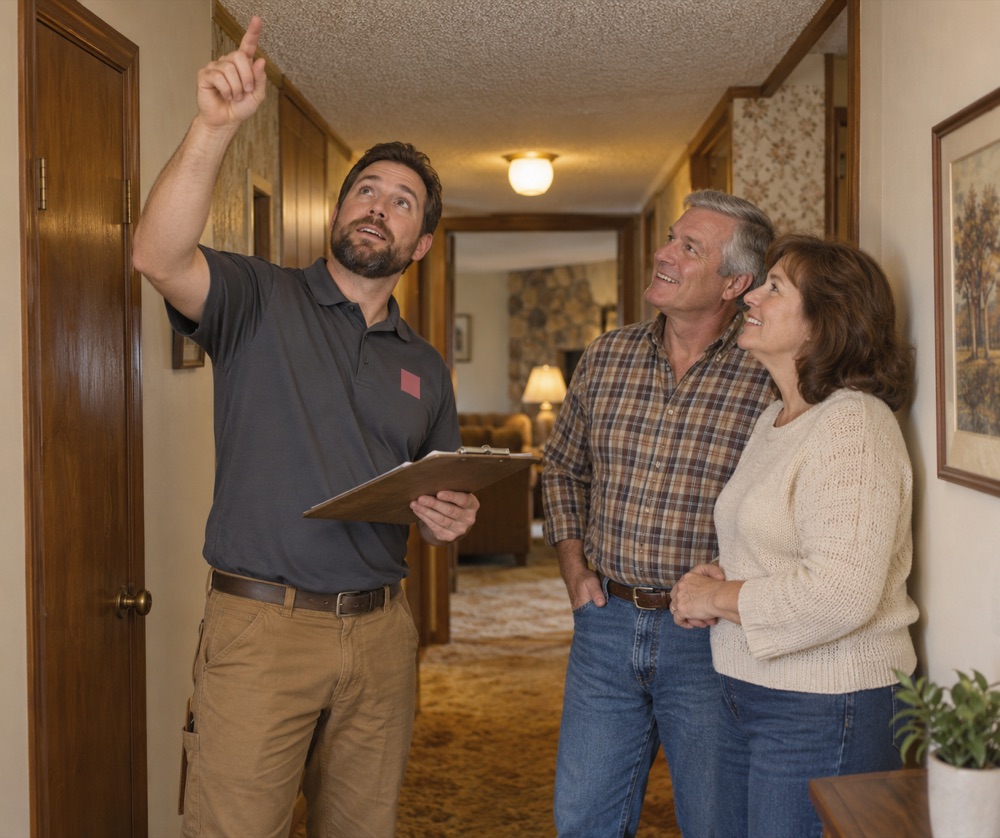 We coordinate. An independent inspector samples.
The sampling visit, step by step
The visit is short. For each distinct ceiling area, the inspector typically:
- Lays a small drop cloth under the sample spot.
- Mists the texture lightly with water to keep dust down.
- Removes a small piece of texture, roughly coin-sized, down to the drywall.
- Seals it in a labeled bag.
- Seals the spot with a patch or sealant so it does not keep shedding.
Each area that looks different, was added onto, or was re-textured at another time gets its own sample. A house where the living room was redone in the 1990s and the bedrooms were not would need at least two.
The EPA recommends against homeowners sampling suspect materials themselves. Done badly, sampling can release more fibers than leaving the ceiling alone.
How long do results take?
Standard turnaround from most labs is a few business days. Faster turnaround is usually available for an added fee if you are working against a closing date or a move-in. The report lists each sample, where it was taken, and whether asbestos was detected, with the type and approximate percentage when it is present.
- VisitA sample from each distinct ceiling area
- LabAccredited laboratory analysis
- Few daysStandard business-day turnaround
- ReportEach sample, location and result
Rush turnaround is usually available for an added fee.
Reading the result
Not detected. We schedule removal and finishing. The report goes into your house records, which is useful if you sell later.
Detected. We do not scrape it. You have three paths, all of which the EPA describes for homeowners:
- Leave it alone. Undamaged material that will not be disturbed can stay. This is a reasonable choice if you are not remodeling.
- Enclose it. New thin drywall can be screwed through the texture into the framing, then taped and finished. The texture stays sealed above. Keep the lab report with the house so a future owner or contractor knows what is up there.
- Have it removed by an abatement contractor. Removal of asbestos material is a specialized job. We refer you to state-certified abatement firms and come back to repair, skim coat and paint once their work is done and the area is cleared.
South Dakota rules for houses
The federal asbestos renovation standard (the NESHAP) excludes residential buildings with four or fewer dwelling units. South Dakota adopted that standard by reference in its administrative rules, and DANR's guidance says single-family residences are usually exempt. Apartment buildings with more than four units, and commercial buildings, are covered. For those buildings, a certified inspector must check the work area before renovation. A notification must reach DANR at least 10 working days before work that disturbs at least 160 square feet or 260 linear feet of regulated asbestos material.
Disposal also has local rules. The Sioux Falls Regional Landfill accepts asbestos only through its special waste request process, and the request form asks for proof of state certification when a commercial contractor did the removal.
None of this is legal advice. If you own a fourplex or a rental with more than four units, call DANR's asbestos program before you plan any ceiling work.
Covered buildings (more than four units, or commercial) need a certified inspection and a notification at least 10 working days before work that disturbs 160 square feet or 260 linear feet of regulated material.
Does testing make sense for newer homes?
If your home was built well after the 1980s and the ceiling has never been patched with old material, testing is less likely to change anything. Many owners still test because it is inexpensive next to the cost of the full job, and it removes the question when they sell. We will give you a straight answer on whether we think it is worth it for your house.